Artificial intelligence is being adopted at a speed that few organizations anticipated. Across industries, employees are experimenting with AI assistants, automating workflows, generating content, summarizing research, and integrating intelligent systems into their daily work. What began as isolated experimentation has quickly evolved into widespread adoption.
For many organizations, this appears to be a positive development. Teams are becoming more productive. Information is easier to access. Routine tasks are being completed faster. New opportunities for innovation are emerging across departments.
Yet beneath this momentum lies a growing challenge that many leadership teams are only beginning to recognize.
AI adoption is accelerating faster than organizational governance.
Employees are embracing AI before organizations have established clear guidelines. Teams are implementing new tools before leadership understands how they are being used. Decisions influenced by artificial intelligence are increasingly becoming part of daily operations, often without visibility, accountability, or oversight.
The result is not transformation.
The result is fragmentation.
Organizations frequently assume that governance becomes necessary once AI initiatives reach scale. In reality, governance becomes necessary the moment adoption begins. Without it, every successful AI initiative creates the conditions for greater complexity, greater inconsistency, and greater risk.
The challenge facing leaders today is no longer whether AI should be adopted.
The challenge is ensuring that adoption does not evolve into organized chaos.
The Illusion of Successful Adoption
Many organizations measure AI adoption through activity.
How many employees are using AI?
How many licenses have been deployed?
How many workflows have been automated?
How many departments have adopted new tools?
While these metrics create the appearance of progress, they often conceal a more important question: Is the organization adopting AI in a coordinated way?
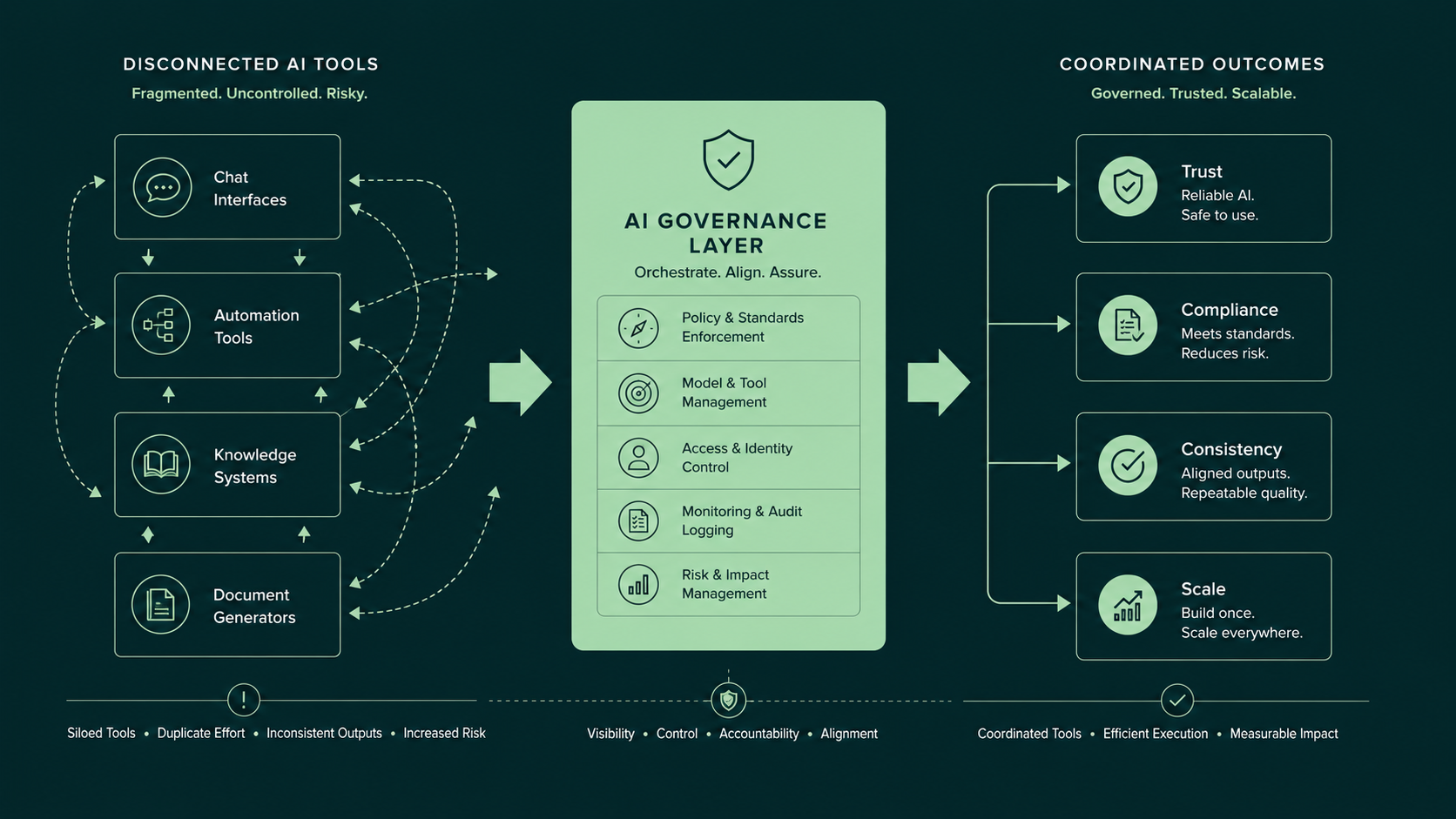
A company may have hundreds of employees using AI every day and still possess no unified approach to implementation. Different teams may use different platforms. Sensitive information may be handled inconsistently. Decisions may be influenced by AI-generated outputs without clear accountability. Knowledge may remain trapped inside isolated systems rather than contributing to organizational learning.
From the outside, adoption appears successful. Internally, complexity is accumulating.
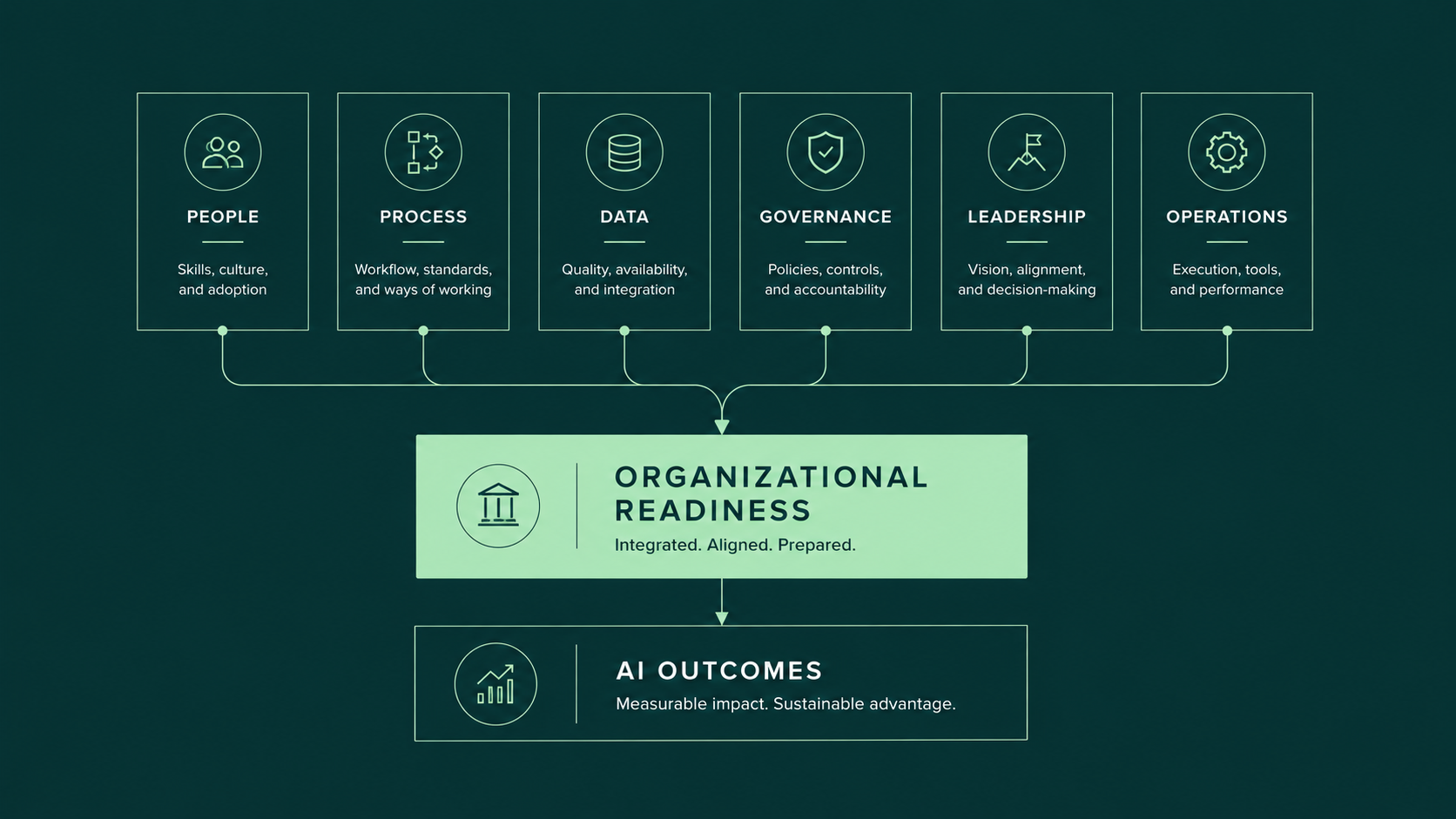
This distinction matters because technology adoption and organizational capability are not the same thing. One measures activity. The other measures readiness.
Organizations often mistake the first for the second.
The Rise of Shadow AI
One of the most significant consequences of rapid adoption is the emergence of what many organizations now describe as shadow AI.
Shadow AI occurs when employees begin using artificial intelligence tools outside formal organizational oversight.
The motivation is rarely malicious. Employees adopt AI because it helps them work faster. They use it to draft emails, analyze spreadsheets, summarize meetings, generate reports, and solve everyday problems. In many cases, they are simply trying to become more effective at their jobs.
The problem is not adoption itself.
The problem is invisibility.
When leadership lacks visibility into how AI is being used, organizations lose the ability to understand where information is flowing, how decisions are being influenced, and what risks may be emerging.
Ironically, the organizations most enthusiastic about AI adoption are often the ones most vulnerable to this challenge. The more useful AI becomes, the more likely employees are to adopt it independently.
Governance is not designed to prevent this behavior.
It exists to make it safe.
Why Chaos Rarely Looks Like Chaos
When executives hear the word chaos, they often imagine system failures, security breaches, or operational disruptions.
In reality, organizational chaos is usually far more subtle.
It appears as inconsistency.
One team develops a process for using AI-generated content while another follows a completely different approach. One department establishes review procedures while another relies entirely on automated outputs. Different versions of information begin circulating. Different assumptions emerge. Different standards develop.
None of these issues appear catastrophic in isolation.
Collectively, however, they create friction throughout the organization.
Employees become uncertain about expectations. Managers struggle to evaluate outputs. Leadership loses confidence in the systems being adopted.
Over time, adoption slows not because the technology lacks value, but because the organization lacks coherence.
Chaos is rarely explosive.
More often, it is cumulative.
The AI Governance Ladder
Many organizations approach governance as a compliance exercise.
This is a mistake.
Effective governance is not a collection of restrictions. It is a progression that enables organizations to move from experimentation to scale.
The process can be understood through what might be called the AI Governance Ladder.
Awareness
Organizations must first understand how AI is being used across the business.
Without visibility, governance becomes impossible.
Guidelines
Employees need practical guidance regarding acceptable use, data handling, and responsible implementation.
Clarity reduces uncertainty.
Policies
As adoption expands, organizations require formal policies that establish consistency and accountability.
Policies create alignment.
Accountability
Clear ownership ensures that decisions influenced by AI remain subject to human responsibility.
Technology does not eliminate accountability.
It increases the need for it.
Trust
When employees understand expectations and leadership understands implementation, trust begins to emerge.
Trust accelerates adoption.
Scale
Only after trust exists can organizations scale AI confidently across departments, functions, and business units.
The mistake many organizations make is attempting to jump directly to scale.
The ladder exists because capability must be built before expansion becomes sustainable.
Governance Creates Speed
One of the most persistent misconceptions surrounding governance is the belief that it slows innovation.
This perception is understandable. Rules are often associated with restrictions. Policies are often associated with bureaucracy. Governance is frequently viewed as an obstacle standing between employees and progress.
Yet the relationship between governance and innovation is often the opposite.
Consider road infrastructure. Traffic signals, lane markings, and speed regulations impose constraints on drivers. However, their purpose is not to prevent movement. Their purpose is to make movement possible at scale.
Without shared rules, transportation systems become unpredictable.
The same principle applies to AI adoption.
Governance provides the structure that allows organizations to innovate safely and consistently. It reduces uncertainty, clarifies expectations, and establishes confidence.
The organizations moving fastest with AI are not those operating without guardrails.
They are the organizations whose guardrails are clearly defined.
From Control to Coordination
The language organizations use when discussing governance matters.
Many governance initiatives fail because they are framed around control.
Control suggests restriction.
Control suggests surveillance.
Control suggests limitation.
Employees naturally resist systems that appear designed to constrain them.
A more useful perspective is coordination.
Governance coordinates people, processes, technologies, and decisions around a common operating model. It creates alignment rather than restriction.
This distinction is particularly important as organizations move toward AI-enabled workflows and decision-making systems.
The objective is not to control every action.
The objective is to ensure that independent actions contribute to a coherent organizational outcome.
Building an AI Governance Model
Organizations seeking to establish effective AI governance should focus on five principles.
Start With Visibility
Understand how AI is already being used before attempting to regulate it.
Create Practical Guidance
Policies should help employees make better decisions rather than simply avoid mistakes.
Define Accountability
Every AI-enabled process should have clear ownership.
Build Trust Through Transparency
Employees are more likely to embrace governance when its purpose is understood.
Design for Scale
Governance should evolve alongside adoption rather than lag behind it.
The objective is not to create perfect control.
The objective is to create sustainable confidence.
Key Takeaways
The conversation surrounding artificial intelligence often focuses on adoption. Organizations measure how quickly employees are embracing new tools, how many workflows are being automated, and how rapidly AI capabilities are expanding.
These metrics matter.
However, they tell only part of the story.
The true challenge facing organizations is not adoption itself. It is ensuring that adoption occurs within a framework that creates consistency, accountability, and trust.
Without governance, AI adoption often produces fragmentation rather than transformation. Different teams develop different practices. Visibility declines. Confidence erodes. Complexity accumulates.
The result is not innovation.
It is organized chaos.
Governance should not be viewed as a mechanism for control. Its purpose is to create the conditions under which innovation can scale safely and sustainably.
The organizations that derive the greatest value from artificial intelligence over the coming decade will not be those that adopt AI the fastest.
They will be those that learn how to govern it effectively.