For more than a decade, business leaders have repeated a simple phrase:
"Data is the new oil."
The statement was powerful because it captured an important truth of the digital economy. Organizations that collected, managed, and analyzed data often outperformed those that did not. Data became the fuel powering personalization, operational efficiency, predictive analytics, and digital transformation.
As a result, organizations invested heavily in data infrastructure. Dashboards multiplied. Reports became more sophisticated. Analytics platforms expanded across every business function. Entire industries emerged around collecting, storing, and processing information.
Yet something unexpected happened.
Organizations accumulated more information than ever before, but decision-making did not become proportionally easier.
Executives gained access to thousands of metrics yet struggled to identify which ones mattered. Teams produced endless reports yet continued to debate the same strategic questions. Businesses invested millions in business intelligence tools while still finding themselves surprised by market shifts, customer behavior, and competitive disruption.
The assumption that more data automatically leads to better decisions is beginning to break down.
The challenge facing modern organizations is no longer access to information.
Information is abundant.
The challenge is interpretation.
The challenge is context.
As artificial intelligence accelerates the creation, analysis, and distribution of information, context is emerging as the true source of competitive advantage. Organizations that can transform information into understanding will consistently outperform those that merely accumulate more data.
The future will belong not to the organizations with the most information, but to the organizations with the greatest understanding.
The Data Delusion
Every generation of business leaders inherits a management doctrine.
In previous decades, organizations pursued scale. Then they pursued efficiency. Then digital transformation became the dominant strategic priority.
Over the last decade, data became the doctrine.
The logic appeared straightforward.
More data should create better visibility.
Better visibility should create better decisions.
Better decisions should create better outcomes.
Unfortunately, reality is rarely so linear.
Many organizations now possess extraordinary amounts of information. Marketing teams track customer journeys in real time. Sales teams monitor pipeline metrics daily. Operations teams oversee dashboards containing hundreds of performance indicators.
Yet despite unprecedented visibility, many organizations continue to struggle with uncertainty.
The issue is not the absence of information.
It is the inability to convert information into meaning.
Data explains what happened.
It rarely explains why it happened.
Information Has Become Abundant
Historically, information was scarce.
Executives made decisions with incomplete reports, delayed market intelligence, and limited visibility into operations.
Today the opposite is true.
Information is everywhere.
Organizations generate customer data, operational data, financial data, behavioral data, and market intelligence continuously. Artificial intelligence can summarize documents, generate reports, monitor competitors, and analyze trends at a scale that would have been unimaginable only a few years ago.
This abundance creates an important strategic shift.
When something becomes abundant, it stops being a differentiator.
Cloud computing followed this pattern.
Internet access followed this pattern.
Digital marketing followed this pattern.
Information is now following the same path.
Possessing data no longer creates advantage because virtually everyone possesses data.
The competitive question is no longer:
"Who has more information?"
The more important question is:
"Who understands it better?"
The Context Deficit
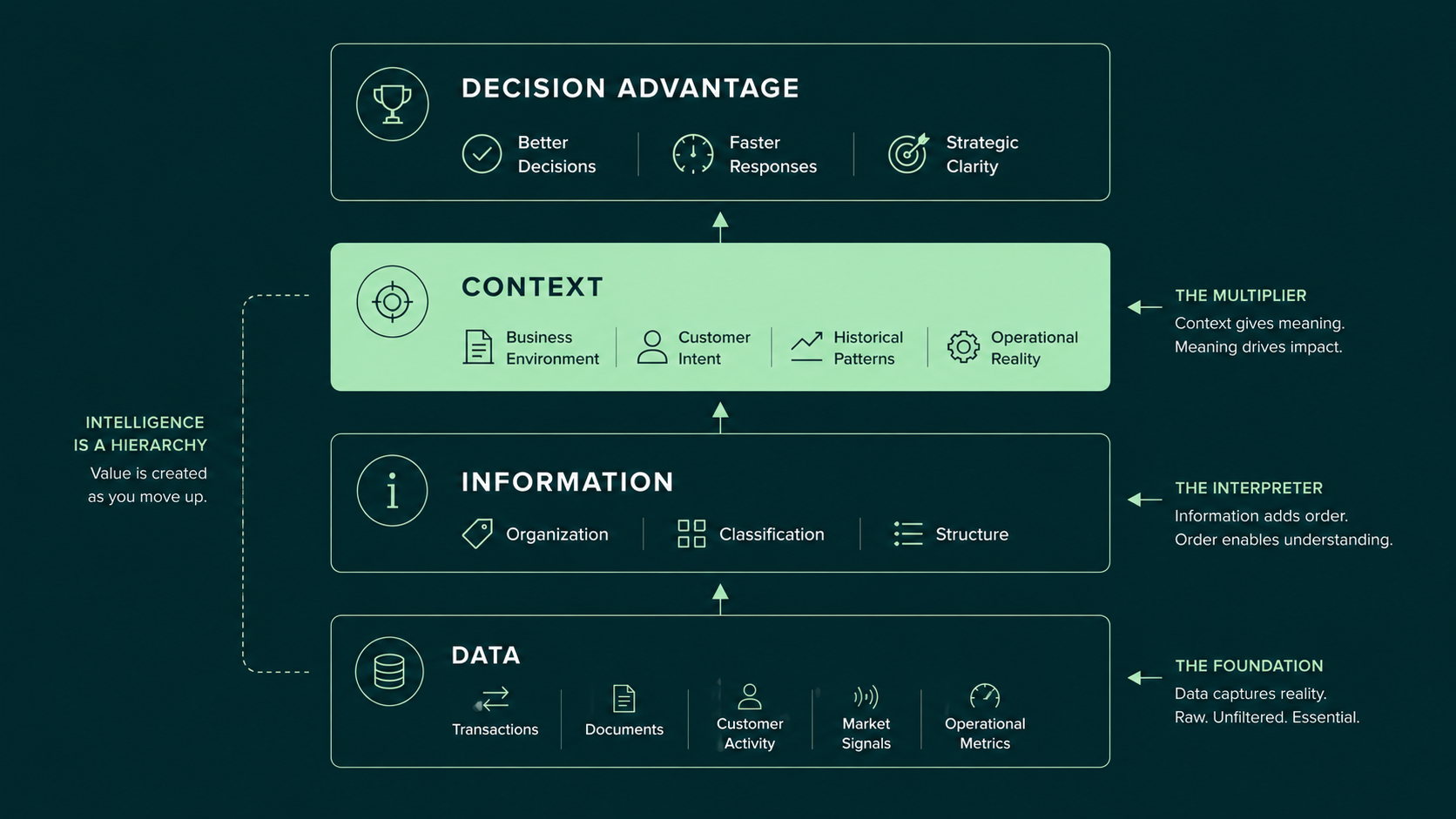
Context is the missing layer between information and decision-making.
It provides meaning.
It explains relationships.
It reveals significance.
Without context, data remains isolated facts.
Consider a simple example.
A dashboard shows customer acquisition costs increasing by twenty percent.
The data is accurate.
But the data alone cannot explain whether the increase is problematic.
Context changes everything.
Perhaps competitors are experiencing similar increases.
Perhaps a new market expansion is driving acquisition costs temporarily higher.
Perhaps customer lifetime value has increased enough to justify the additional investment.
The same data can support entirely different conclusions depending on context.
This is why organizations frequently possess the same information yet arrive at different decisions.
They are not interpreting the data itself differently.
They are applying different context.
The Decision Intelligence Gap
Many organizations invest heavily in business intelligence.
Far fewer invest in decision intelligence.
The distinction is important.
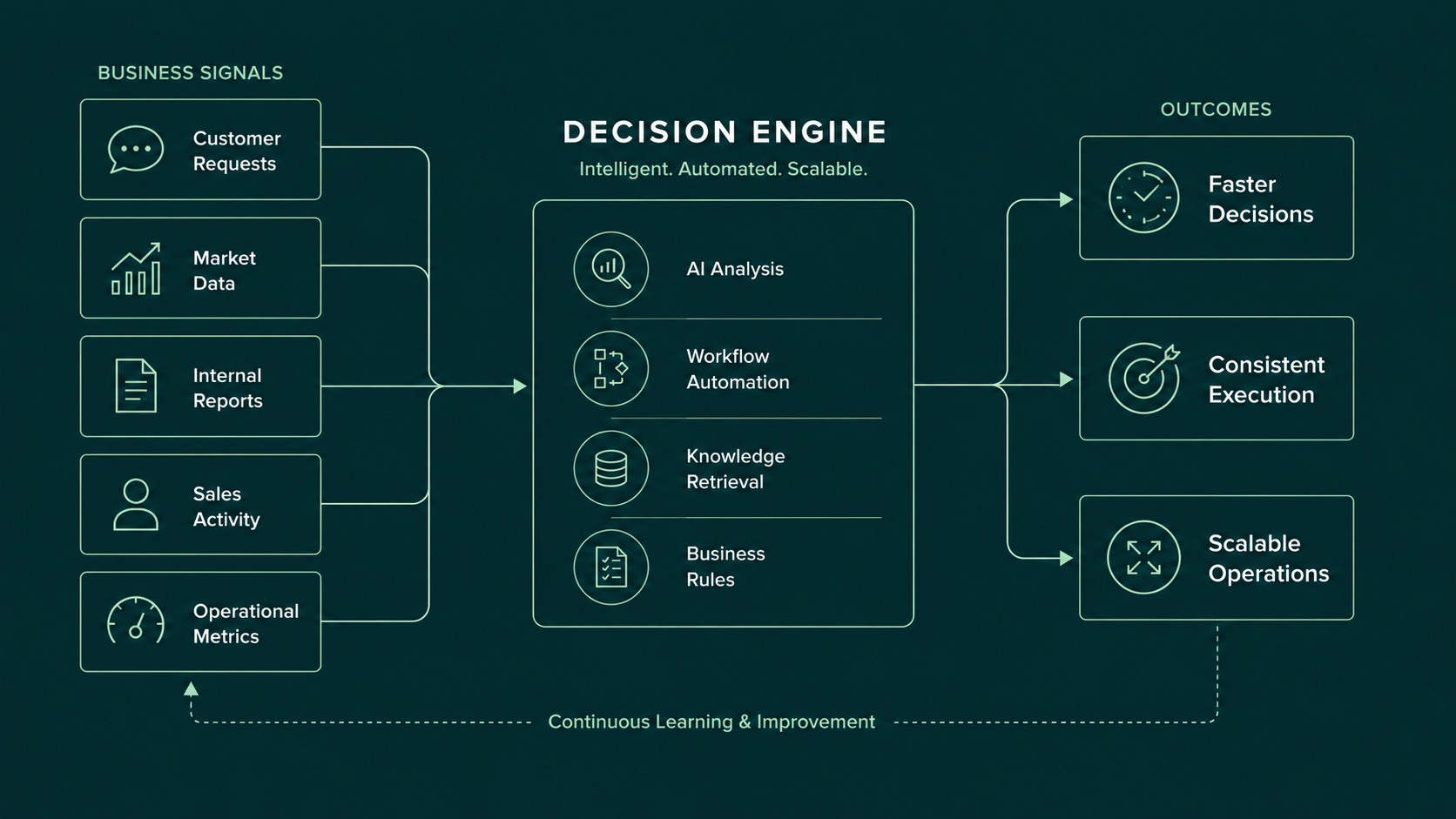
Business intelligence focuses on reporting information.
Decision intelligence focuses on enabling action.
A dashboard may reveal that revenue growth is slowing.
Decision intelligence helps leaders understand:
- Why growth is slowing
- What factors are contributing
- Which interventions are available
- What outcomes are most likely
Information answers questions.
Context informs decisions.
The organizations that create sustainable advantage are those that bridge the gap between the two.
When More Data Creates More Confusion
Conventional wisdom suggests that more information reduces uncertainty.
In practice, excessive information often creates the opposite effect.
Decision-makers become overwhelmed by competing signals.
Teams spend more time analyzing than acting.
Meetings become exercises in reviewing dashboards rather than making decisions.
This phenomenon is becoming increasingly common in organizations adopting artificial intelligence.
AI can generate insights rapidly.
The challenge is determining which insights matter.
Without context, organizations risk replacing information scarcity with information overload.
The result is paralysis rather than progress.
Context as a Competitive Advantage
The most valuable organizations of the future will not necessarily possess the largest datasets.
They will possess the strongest contextual understanding.
They will understand:
- Their customers more deeply
- Their markets more accurately
- Their competitors more clearly
- Their operations more comprehensively
Most importantly, they will understand how these elements interact.
Context transforms information into insight.
Insight transforms decisions.
Decisions transform outcomes.
That chain is becoming one of the defining competitive advantages of the AI era.
Building Context Systems
Context cannot be created through technology alone.
It must be designed into the organization.
Five components are particularly important.
Organizational Memory
Historical decisions provide critical perspective.
Organizations that capture and learn from prior decisions develop stronger judgment over time.
Business Rules
Data becomes meaningful when evaluated against strategic objectives, operational constraints, and organizational priorities.
Decision History
Understanding previous outcomes helps leaders interpret current signals more effectively.
Market Intelligence
Context extends beyond internal operations. External market shifts often explain internal performance changes.
Human Judgment
Artificial intelligence can process information.
Humans provide perspective.
The strongest systems combine both.
The Future Belongs to Context-Rich Organizations
Artificial intelligence is making information cheaper, faster, and more accessible than ever before.
This trend will continue.
Reports will become easier to generate.
Analysis will become easier to automate.
Insights will become easier to obtain.
As this happens, information itself will become less valuable.
Context will become more valuable.
Organizations that build contextual understanding into their workflows, decision-making processes, and operating models will consistently outperform those that simply accumulate larger quantities of data.
The winners of the next decade will not be the organizations with the most dashboards.
They will be the organizations that understand what their dashboards actually mean.
Key Takeaways
For years, organizations were told that data is the new oil.
The statement reflected the realities of an earlier era.
Today, information is abundant.
Artificial intelligence is accelerating that abundance even further.
The scarce resource is no longer data.
The scarce resource is context.
Data can tell organizations what happened.
Context explains why it happened.
And understanding why something happened is ultimately what enables leaders to decide what should happen next.
The next competitive advantage will not come from collecting more information.
It will come from creating better understanding.
In the age of artificial intelligence, context is becoming the most valuable asset an organization can possess.